


Almost every athlete’s dream is to go professional, but the dedication, discipline and time management behind that goal often go unseen. For m
any, the outcome makes the hard work worth it.
Some seniors committing to play at the next level share how they overcome these challenges to succeed in the sports they love.
Jackson Kern
Senior Jackson Kern plans to go to the University of California, Irvine for volleyball. Kern had been playing volleyball since he was 10 years old, but things changed when he started to get serious.
“Probably around my freshman or sophomore year,” he said, “I went to USA National Camps and worked with college coaches, and that kind of developed my love for the game.”
As his passion grew, so did the pressure. From coaches to parents to even himself, Kern grew to cope with this pressure while continuing to play the sport he loves.
“I try to tone out the pressure and expectations; you know they’re there, but you just have to ignore them and keep playing your best,” he said.
Besides pressure, Kern and many other student-athletes deal with a common challenge: time management. One of the most important things about being a student-athlete is being both a student and an athlete.
“The biggest challenge as a studen
t-athlete is definitely managing time,” Kern said. “Finding time to get academics done first, then planning everything else around volleyball.”
But, from pressure to time management, he didn’t have to go through it alone. One of the pros of being a student-athlete is that it often comes with a strong support system to help them in times of need.
“My parents definitely have had the biggest impact, along with my friends, teammates and coaches,” Kern said. “A lot of people have pushed me to be the best version of myself.”
Kern is thrilled to continue his volleyball career in college at UC Irvine.
“Being able to compete at a higher level and learn from the coaches and staff there is something I’m looking forward to,” he said. “Committing hasn’t changed my mindset a lot; it’s given me peace of mind knowing where I’m going, but I’m just excited to keep competing.”
Izzy Karl-Garcia
Senior Izzy Karl-Garcia is committed to the University of Nevada, Las Vegas as a distance runner for track. However, she didn’t follow the norm
al path. Instead of starting at a young age, Karl-Garcia decided to join track during her freshman year. After conflicts with soccer and track, she decided to quit soccer to focus on her present sport.
“I kind of knew right away that I wanted this in college,” Karl-Garcia said.
Despite being new to the sport, she felt confident enough that she could build up that skill in a mere four years. From just a beginner in track to a varsity starter, Karl-Garcia has developed a reputation as a disciplined athlete for her team.
“With running, it’s a lifestyle,” she
said. ”Everything feeds into it: my time, my nutrition, weekends, hanging out with friends–honestly, all of it.”
Beyond the sport itself, recruiting is a challenge. Thousands of athletes compete for limited spots, making both performance and self-promotion essential to participating in college.
“The recruiting process was definitely stressful, but honestly so rewarding,” Karl-Garcia said. “It was really cool to see the different attributes each school has.”
After numerous college visits, emails with coaches and camps, Karl-Garcia chose UNLV to continue her track career, and is very excited for this new opportunity.
“It’s almost like everything is laid out for you,” Karl-Garcia said. “You just have to show up and do what you’re supposed to do. The amount of resources, both athletically and academically, will be really nice.”
Myles Batesky
Senior Myles Batesky committed to Harvard University for football. A star offensive lineman, Batesky drew attention from many colleges, but ultimately chose Harvard.
After starting football 12, Batesky became serious early on, knowing opportunities would follow.
“Freshman year was when I realized I needed structure—practice, lifts and classes—just to succeed,” he said.
His dedication to the sport paid off as recruiting kicked up.
“I got my first offers right after my sophomore year,” he said. “But, after my junior year [was] when I got the majority of them.”
But, just getting offers wasn’t where the story ended. In fact, more challenges came up as a result of these new opportunities.
“A lot of the schools recruiting me had rigorous academic standards,” Batesky said. “So, staying on top of school while performing as an athlete
was probably the toughest part.”
Despite the many challenges, Batesky had many people to fall back on, including his coaches, parents, friends and teachers. Their positive support system helped make him into what he is today.
“Coach Shack and Coach Budge were massive positive influences on me, both athletically and academically,” he said.
After his four years of hard work, Batesky received an offer from Harvard and committed to football there.
“Once you commit, it kind of makes you feel older,” he said. “You start to feel like a veteran, and you have to hold yourself to a higher standard.”
Batesky’s high school experience taught him many life lessons, especially in the world of sports.
“Don’t be afraid to push yourself; surround yourself with people who want you to succeed, not bring you down,” he said. “If you can put your mind to it, you
can do anything.”
Jack Treutelaar
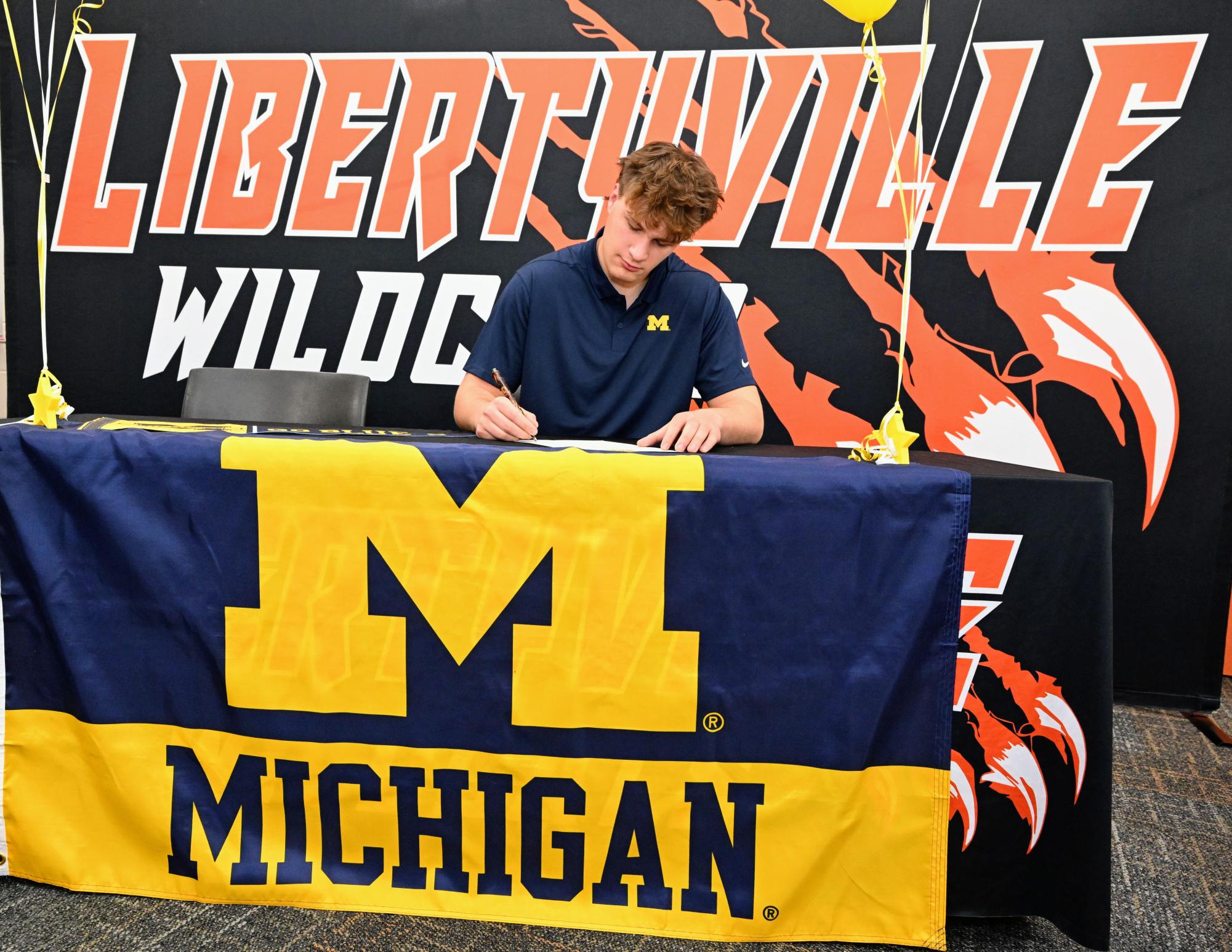
Senior Jack Treutelaar is a long snapper on the varsity football team and committed to the University of Michigan. Starting at a young age, Treutelaar was determined to play football in college.
“I’ve kind of always wanted to–my dad played football at Purdue, so that’s always been a goal of mine,” he said. “I think around eighth grade is when I really figured out I could do this.”
The process of transitioning from playing flag football to committing to college football was difficult, though.
“Specialists are usually the last to go, so the process was long and stressful; I didn’t get picked up until a couple months ago,” Treutelaar said. “I rem
ember being one of the last ones to go, but I’m happy where I ended up.”
Finding time to have a social life, manage academics, and excel in football is a skill only some can manage; Treutelaar being one.
“Hanging out with friends, early mornings, late nights–just making sure everything is in line with football and school,” he said. “My dad has always been there supporting me and pushing me; he helps me clear my head.”
Besides the physical demands, Treutelaar, like every other athlete, also faces mental challenges.
“I just try to have fun and keep a smile on my face–that takes some of the pressure off,” he said. “I tell myself, ‘you do this so much it becomes muscle memory’ and ‘the more you think about it, the more stress you put on yourself.’”