


For the past two years, the discussion on equity and Title IX has been discussed at multiple board meetings. A group of local moms has been advocating for D128 to address Title IX equity concerns regarding athletics at LHS and VHHS. The initial goal was to ensure that D128 complies with Title IX obligations so that every student has a fair and equitable athletic experience.
By the fall of 2024, parent advocacy groups observed and documented how D128 handled their complaints on athletic equity, booster club fundings and district procedures. However, as stated in a Facebook post from March 7 by Susan VanBoening, a parent of two D128 graduates, she and others felt that investigative protocols were not being followed.
The advocacy group raised the concern that if the district could not follow procedures regarding equity concerns, they would not know what would happen if something more serious was reported.
There has been attention recently to a lawsuit filed alleging sexual assault. Due to the equity concerns raised by the advocacy group and how Title IX covers sexual harassment, this raised apprehension.
How Title IX Works
Title IX of the Education Amendments of 1972 states that sexual discrimination is prohibited in federally funded education programs, both public and private. Since being enacted, Title IX has increased athletic opportunities for women, according to the Northwestern Journal of Law and Social Policy.
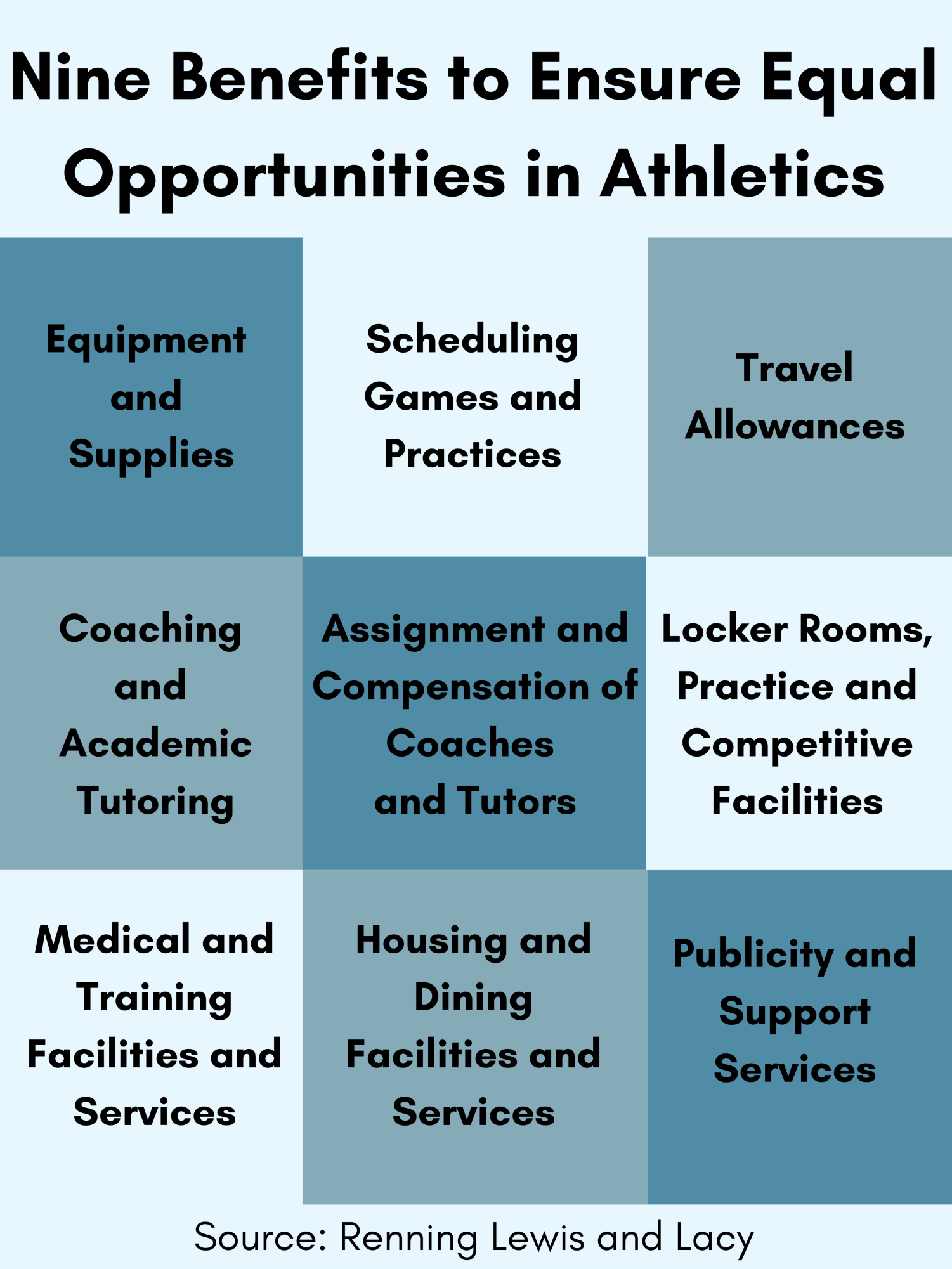
Title IX has three basic parts in how it applies to athletics. It includes equitable opportunities to participate in sports, equitable athletic scholarships proportional to participation and equal treatments in benefits for male and female students, according to the National Collegiate Athletic Association.
“When you’re looking at basketball, [you look at equitable activities]…in terms of the number of games, number of practices, and so forth,” Associate Superintendent and D128 Title IX Coordination
Mr. Briant Kelly said. “Internally, you can analyze all that by looking at your schedules. You could look [by] comparison of coaches for the number of teams and athletes. You can compare your budgets [and] your participation numbers.”
Booster Club Funding
Booster clubs are separate organizations run by parents of students in the athletic organizations that they support. Once a school accepts booster money, it becomes subject to Title IX obligations.
It is up to D128 to approve and oversee the booster clubs to ensure compliance with Title IX.
Athletic funding in D128 is from a variety of sources, including district budgets allocated to extracurricular activities and athletics.
“Those budgets are the same budgets that fund a lot of stuff in the classroom,” Mr. Kelly said. “So it’s really from tax dollars that come in, and so those budgets are helping to fund facilities, equipment, uniforms and then coaching stipends.”
Fundraising can also finance athletics, such as from athletic teams fundraising for their own team, donations and booster clubs. Currently, VHHS has one single all-encompassing booster club, compared to the eight LHS has.
“I wouldn’t say that [the booster clubs are] evenly distributed,” Mr. Kelly said. “It’s based off of the coaches and the athletic director… There are some teams that do their own internal fundraising, [like] at Vernon Hills… So there is a little bit of a difference between the schools.”
D128 follows the guidelines put in place by the National Federation of State High Schools (NFHS) to analyze the athletic programs. The NFHS states that athletic leaders should work closely with the Title IX Coordinator, along with training coaches and staff regularly. Every year, the D128 athletic directors, Mr. Kelly and the Assistant Superintendent for Finance, Mr. Dan Stanley, analyze the number of coaching stipends and the number of athletes to set budgets and ensure that the teams have access to supplies and things that they need to operate.
“Title IX doesn’t say that every [team] has to have the same amount of money,” Mr. Kelly said. “It’s that you’re providing an equitable opportunity.”
However, with regards to LHS’ current model of eight separate booster clubs, parents like Ms. Laura Weber have raised concerns that separate booster clubs create inequitable resources between boys and girls teams, specifically in terms of external donation dollars.
External donation dollars can be given to sports teams through fundraising that the team does on its own, money that booster clubs raise and any outside donations.
“Whether it comes in through the school, or whether it’s coming in through the boosters, it all needs to be tracked because the school is required to ensure that there are equitable experiences for athletes,” Ms. Weber, parent of a LHS graduate and twins about to enter high school, said. “So not equal, because that would be impossible to manage, but equitable. Multiple booster clubs can be seen as a risk for Title IX violations because they can raise unequal funds for boys and girls teams, NFHS states.
A unified booster model like VHHS can allow for central funding, easier oversight and reduce inequalities between sports programs.
“As of right now…the action plan that we have is sticking with the eight booster clubs at LHS, and having them meet yearly with the athletic director and then update and submit their articles and incorporation of bylaws, [and] then also submit their financial report,” Mr. Kelly said.
Title IX Audit
The subject of the Werchek building within the football field groundshas also been subject to equity concerns among parent advocacy groups. The building currently has locker rooms for boys but not a facility for girls to use.
“It’s surprising it even got built the way it is because I think that Title IX was already passed at the time,” Ms. Weber said. “It only was built as locker rooms for football players, essentially for male athletes. That makes it a non-compliant athletic facility because it should have female and male locker rooms.”
As a result of the parents’ concerns, information was brought to the D128 administration and meetings were had. An audit was completed on Dec. 23, 2024, by the external law firm Kriha Boucek LLC, with participation data from 2020-2024. Parents, students, coaches, athletic directors and others were interviewed to get feedback.
There was no evidence found of gender inequality in equipment, scheduling, travel or meals. For coaching and training, the hiring processes and stipends were deemed consistent across boys and girls teams, as stipend amounts depend on sport type and experience level, not gender.
However, the audit found concerns with the LHS football team having better access to locker rooms than other sports teams. The audit reported that a student said that the LHS softball field is also not maintained as often by the Buildings and Grounds crew as the baseball field, and the baseball field can be accessed without permission, unlike the softball field.
“The Buildings and Grounds department was made aware of [the softball field] concern, and they have sought to remedy from this report in December 2024,” Mr. Kelly said in an email follow-up.
The audit also noted that male students receive greater additional benefits from private donations than female students, which can lead to a Title IX violation if inequalities are proven, and that liability for D128 should be addressed.
As a result of the audit done in Dec. 2024, Mr. Kelly presented a Title IX Audit Action Plan at the Jan. 28 D128 board meeting, including adjusting locker room assignments for spring athletes and a locker room survey being distributed to students and staff.
However, some parent advocates do not see a clear plan for reviewing the financial numbers or what will happen if there is inequality in how sports teams are receiving benefits.
“Legally, the school is required to pay attention to what the booster clubs give athletes,” Ms. Weber said. “I don’t know if they didn’t know it, but they weren’t paying attention to [the finances]. [We] actually had to call this to their attention for them to start asking for paperwork.”
The Title IX Audit Action Plan was updated on March 12, 2025, including locker room assignments changes at the Werchek building, where the football team would be assigned during the fall, and the girls soccer and girls lacrosse would have the spring. The action plan also included addressing funding and booster club disparities by conducting a financial review in the summer.
However, notes were made about female athletes not being able to get to the Werchek locker room when their season started, so some were changing in their car or in the locker rooms all the way in the high school.
An Ongoing Discussion
Since the audit, action plan and updates, additional advocacy by parents has been done through Facebook and by submitting Freedom of Information Act requests to D128. Promoting oversight and accountability over the booster club models, facilities, resources and coaching are the parents’ goal.
“While [D128 is] collecting this paperwork, they need to look at every dollar that comes in, and it’s not always through a booster club or any gift that comes in,” Ms. Weber said. “They need to evaluate it at that level.”
As Title IX covers equitable opportunities, scholarships, equipment and supplies within athletics, it can be important for members within the community and D128 to stay informed and continue to review Title IX to ensure compliance.
“I don’t think girls understand truly what they are entitled to under Title IX,” Ms. Weber said. “Something that would be so great is just to make sure athletes understand what they are entitled to and what they may not be getting, and that they should start to ask some questions.”