

Note: This piece is a staff editorial, which is an opinion article meant to reflect the opinions of the Drops of Ink staff. Because of this, the author’s name does not appear alongside the story, as the opinions shared in here are based on class discussions about the topic among the 10 DOI staff members. The staff is composed of students of all grades from a variety of backgrounds and experiences; therefore, the editorial speaks to the publication’s view on a subject and is not representative of each staff member’s exact view on the issue at hand.
In our world, news travels at faster speeds than ever before, globally connecting our world in ways we could only imagine centuries ago. But where do we get our news from? And how accurate is the information that is spread?
To answer that first question, the root of news is often discovered by journalists and reporters who actively seek out what is going on in the world. They then extend the information they’ve found and reported on to publications, such as The New York Times, and news channels such as CNN or Fox News. From there, collected news stories are sent out to all citizens willing to watch or read the news, and that’s how information gets posted onto social media.
This leaves us with the question of accuracy. After all, we’ve all been told not to trust everything we see online.
Accuracy in News
Despite this common warning, research from the Pew Research Center has found that one in five young adults in America get their news from TikTok – a social media platform that has historically spread misinformation.
“The less that journalists are trusted, the more that, especially today, people go to social media for their news, or go to places for their news where it might not always be true,” one staff member said.
As trust in journalism declines, algorithms step in to fill these gaps, playing off of opinions personalized to their users. Algorithms, by design, show users content similar to their own beliefs, creating echo chambers that can bring more harm than good in the long run. And thus, misinformation is spread, and biased news finds its way onto the feeds of many through social media algorithms. This only makes finding and reporting the truth in journalism so much more important these days. Finding the truth goes beyond discovering information, though.
“Truth is backed by sources,” another staff member said. “Most people are not going to look at both sides, [which is] what you should do to get news.”
This is also known as cross-checking. Cross-checking combats inaccuracies and biases from being further spread, making it almost a counter to algorithms. It is especially used in journalism, but is uncommon on social media, where content is consumed quickly and emotionally without pause for verification.
Obstacles In Getting The Truth
Many professional journalists go out in the field where they can best gain insight firsthand, and in the process, they make sacrifices in order to search for the truth and face big consequences for simply doing their job.
For some, the truth hurts, and people don’t always want to hear it. This creates a barrier between the truth and truth-seekers; accurate information isn’t always readily available, and some parties may manipulate or even hide the truth for their own personal benefits. While the First Amendment, freedom of speech, certainly does exist, it is tricky to make free claims with little evidence and sources to back those claims up if the truth is obstructed by third parties. This only further complicates reporting in journalism at times.
Fortunately for school publications, a precedent set by the Supreme Court in 1969, due to the Tinker v Des Moines court case, protects the right of free speech for students. Tinker prevents schools nationwide from censoring students’ speech unless they can accurately prove that said speech is disrupting education.
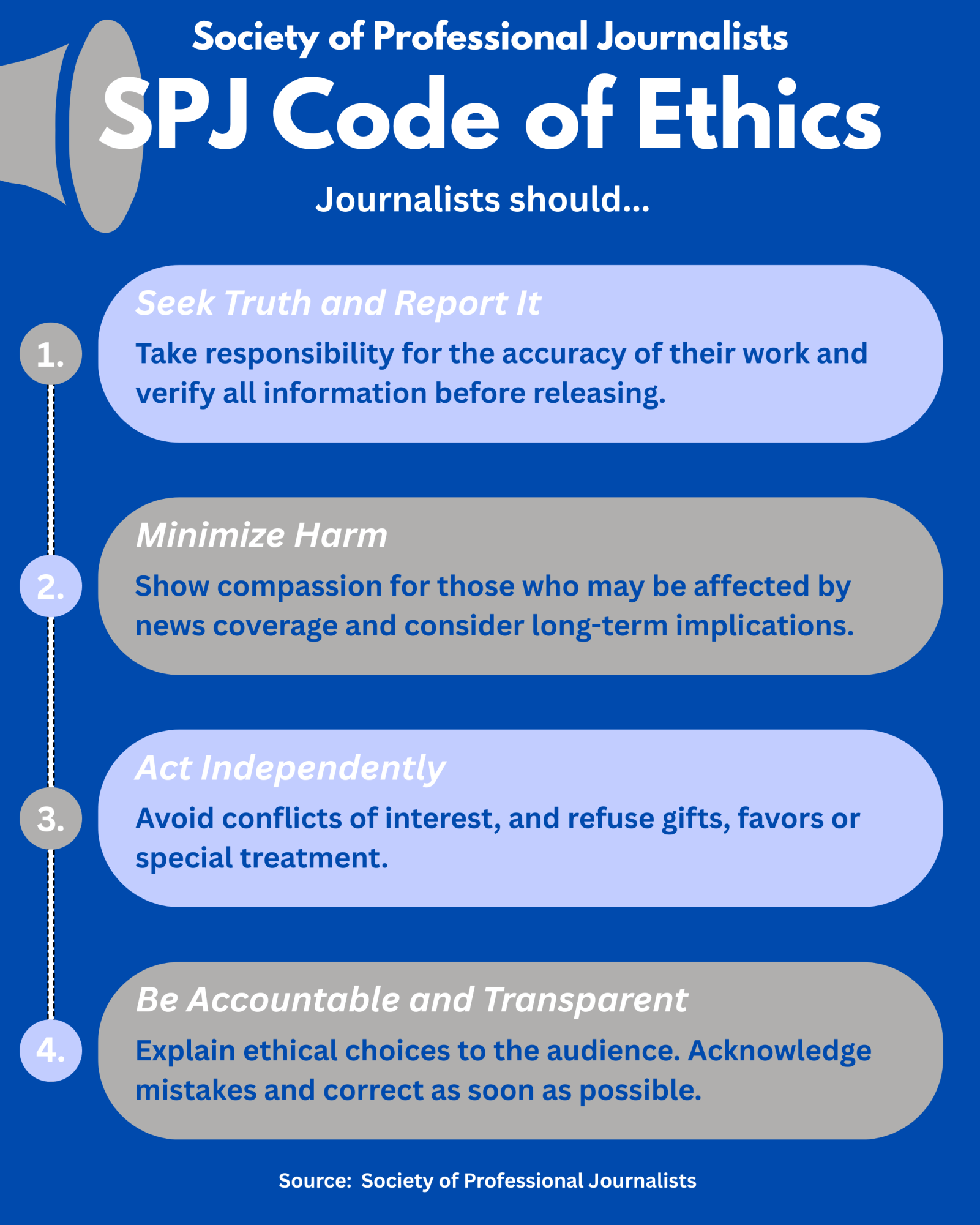
While the Drops of Ink publication does not operate on as big of a playing field as other, more influential and well-known news publications, we still abide by the Journalism Code of Ethics, one of the core principles being seeking truth.
“As people in high school, we get our news from other news sources, and then we try and fact-check it with other resources,” a staff member said. “But again, that’s still not getting to the root of the news. So that could still, without us knowing, have an unconscious effect on what we put out.” This is where, once again, cross-checking plays such a crucial role in fact-checking and preventing the spread of misinformation.
It is always better to stay accurately informed, and journalism – no matter what level it may be at – strives to achieve exactly that for all readers alike.