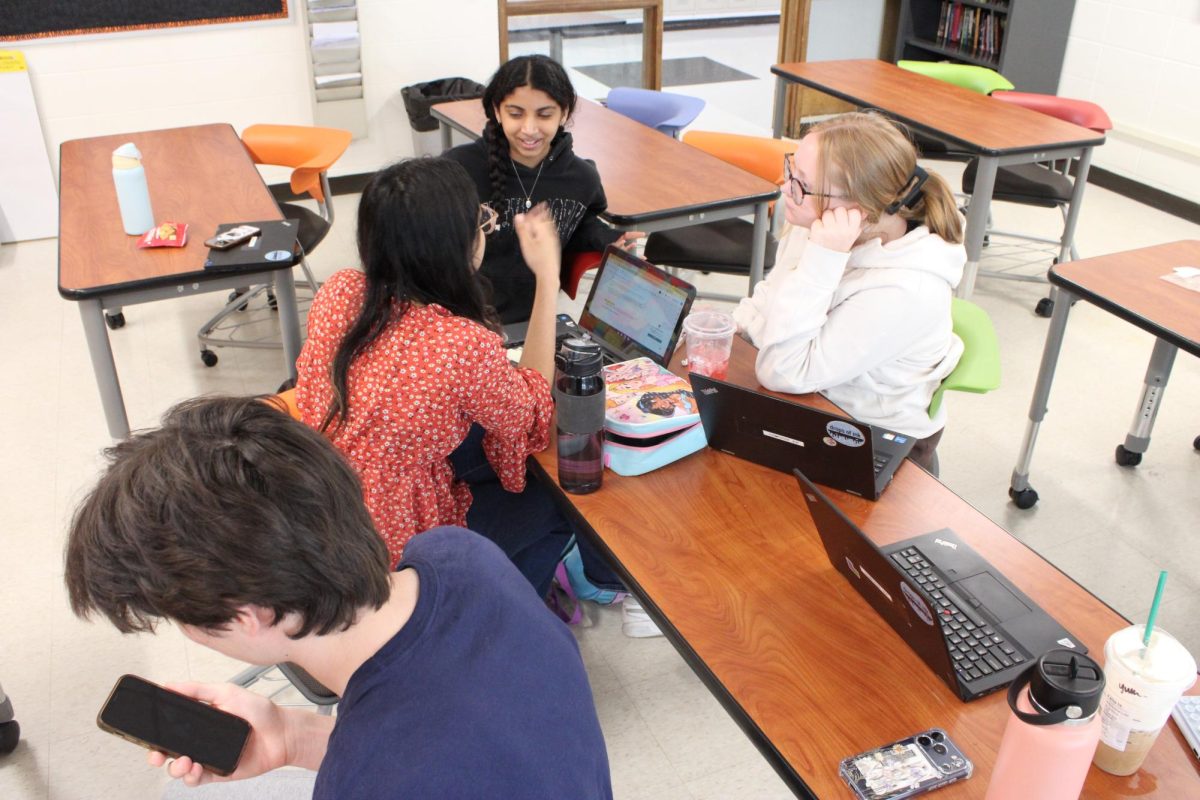

![Drops of Ink seniors struggle with completing assignments as the school year comes to an end. “One of the reasons [for burnout] is because we've been doing the same thing for years, and so after a while, it becomes routine,” a DOI senior said. “So, well, this is the last little bit, so I don't think I really need to put in 100% effort anymore.”](https://www.lhsdoi.com/wp-content/uploads/2026/05/staff-ed.jpg)
A student turns in every assignment on time—and still hasn’t.
Yet, their perfect GPA sends a different message. So what,
exactly, are we measuring: learning, or just compliance?
Senioritis and burnout have always deeply affected seniors,
especially in their second semester. These students’ attendance
often fluctuates, fewer assignments get turned in and test prepa-
ration becomes nonexistent. The seniors of DOI have seen this
effect on their classmates and themselves.
From prioritizing sleep to choosing mental well-being and social
presence over stress, seniors are experiencing a serious lack of
motivation after four years of constant drive and pressure, both
internal and external.
“Everything we did was to get to college,” a DOI senior said.
“Once that’s done, there’s no motivation.”
After committing to an institution for higher education, some
students feel there’s little consequence to getting a B in a class
they usually get an A in, or even a C in a B class. The DOI seniors
think that it’s because school isn’t a priority like it used to be.
“I’m prioritizing my friends and family more than I am school,
because I’m leaving in a couple of months,” another DOI staff
member said.
With the start of a new chapter coming so soon, seniors start
to wonder: what really is important? With their future still being
attainable despite the bare minimum effort put into schoolwork,
why shouldn’t seniors focus on things that make them feel better
in the present?
This change in mindset changes seniors’ work ethic. Even the
most driven, devoted students may take this chance to step back.
But, now with the introduction of artificial intelligence to the
general population, students are starting to wonder: Is it possible
to prioritize other parts of our lives without having grades be
affected if we just use AI?
With this new tool, students can hide the extent of their inabili-
ty to work. Assignments still get turned in, even if the student did
not complete it themselves. Classes are passed, even with minimal
effort, and teachers and parents are unable to catch the differ-
ence.
“The problem is [it’s] possible to pretend like we’re good stu-
dents for a year,” a DOI senior said.
Another DOI senior noted that many assignments this year that
they’ve used AI for were in classes that don’t interest them. This
leads to students not understanding the material and doing even
worse on tests, lowering their motivation even further. This leads
to an endless loop of unwillingness to do work for their classes.
However, in classes that interest them, they find learning
interesting and are passionate about actually completing that
work. In college, the DOI seniors believe that this approach will
change.
“I’m not gonna use AI for the classes I want to take because I’m
choosing them and I want to take them,” a DOI senior said.
While society has yet to see the full long-term effects of AI
in school, the DOI seniors have already observed this effect on
themselves and their peers.
“People aren’t thinking critically anymore,” a DOI senior said. “We
have the same ideas circling and circling because AI gets its ideas
from things that are already known and that people have already
put out.”
In today’s world, where burnout and stress are increasingly
prevalent, AI is changing the way students react, making dis-
engagement easier to hide. This problem goes beyond simple
senioritis or exhaustion. Relying on AI will become even more
widespread, and our society must take into account the effect it
may have on our future.