


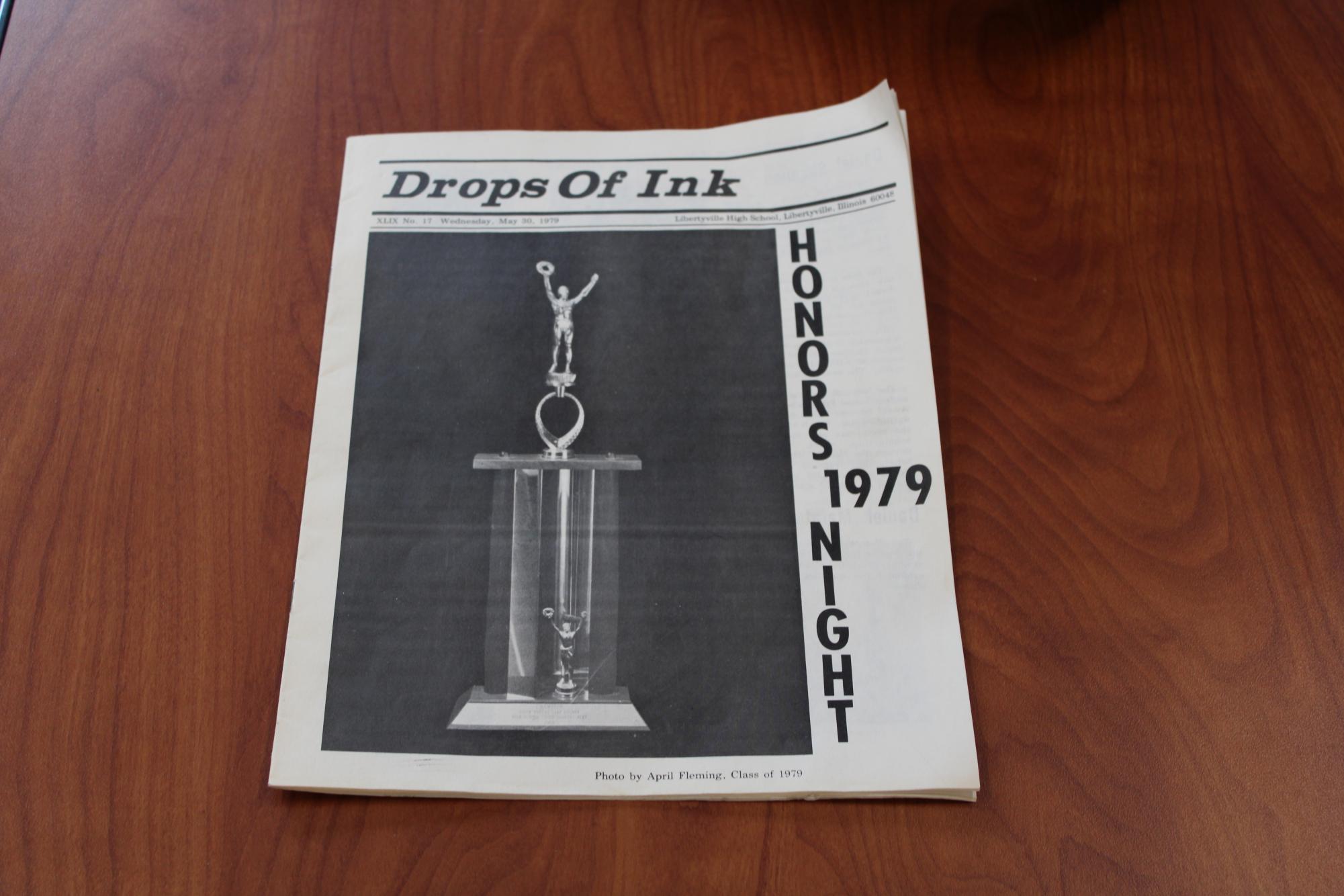
Drops of Ink was founded in February 1926. Now in 2026, the publication is celebrating its 100th birthday. To celebrate this milestone, we are taking a look at some Drops of Ink issues from both the past and the present, celebrating the many writers and editors we’ve had on staff and the hard work they put in to make the publication what it is today.
“Drops of Ink Begins Journalism Class”
1956
“The new journalism class which will start on February 19, will be open to freshmen, sophomores, and juniors, and will meet in the homemaking laboratory. In order to become a member of the Drops of Ink staff it is necessary to attend at least ten of the twelve meetings. Very little homework will be required. The staff hopes for a large enrollment since there will have to be a larger staff next year because of the two school buildings.”
From this point going forward, Drops of Ink became part of the curriculum, rather than an extracurricular. Allowing it to count as an English credit, the publication became popular—increasing its recognition as one of the most important voices of LHS.
“DOI Announces New Policy”
1964
“An editorial is an ‘an article… presenting the opinion or comment of the periodical.’ Certainly it would be fruitless to even try expressing everyone’s views in this section. And certainly there would be no point in such an article if it did not get to the very heart of the subject.
Therefore, editorials of this paper shall reflect the views of the staff or guest editorials only. Items discussed will be chosen on the basis of significance; facts will be given to relay the truth. The subject matter may often prove to be controversial. Yet it shall only be printed when the criticisms are found to be constructive and related to the student body. It shall be aimed at stirring interest and proper discussion, for it is these two qualities that keep an active and educated citizenry. Letters for publication will always be welcome from students, faculty, administration, and parents.”
Through an initial copy of the policy, Drops of Ink established the historic staff editorials. This marks a historic moment for the publication, as even now, the magazine. vigorously presents constructive, yet possibly controversial, opinions. Keeping readers entertained and informed, DOI has upheld this tradition for over sixty years, and will continue to do so for even more.
“The Fall of Facebook” by Molly Downing
April 10, 2014
“Remember in 8th grade when everyone was on Facebook? People used to spend hours of the day messaging their friends, writing clever statuses, or even taking care of a virtual farm.
So, why has the use of Facebook among teenagers been decreasing in the last couple of years?
According to an unscientific survey of 150 Libertyville High School students, the four most popular social media among LHS students are Instagram, Twitter, YouTube, and Tumblr. That being said, what happened to Facebook? Facebook was created on February 4, 2004, in Cambridge, Massachusetts by Mark Zuckerberg while attending Harvard University. The site had a slow increase of hits from November 2006 at 1% of its total popularity to December 2012 where it reached its highest peak at 100%. Then, in January 2013, the usage of Facebook slowly started to decrease, according to Google Trends. There are a lot of good things about Facebook. Facebook helps people keep in touch with each other. If a person doesn’t have someone’s phone number but needs to shoot them a quick text, they can use Facebook messenger, which works the same way as the texting app on any smartphone. People can send e-vites to events, which can be delivered instantly. They can reach more people than a written invitation could and, by inviting people over Facebook, people don’t have to spend a lot of time searching for the address of every individual person. Facebook can be a confidence booster. Who doesn’t feel good when they open Facebook on their birthday to a stream of happy thoughts and good wishes, get good feedback on a selfie, or get tons of likes on a status?”
Even just twelve years ago, there was a distinct difference from today’s society. This article showed Facebook is still popular among youth, compared to today, when it is generally seen as something for Millennials. Now kids are rarely on Facebook in favor of TikTok, Instagram and X (formally known as Twitter) .
“Tension in the Air: Russia and Ukraine” by Marijke Sommer
July 2, 2015
“February 2014 marked the beginning of the Russian and Ukrainian crisis, which has continued throughout this year. Recently, there has been little government-sanctioned fighting between these two countries although there have been a few skirmishes.
This crisis was a result of a plethora of reasons including the ethnic divide in Ukraine, Russia’s dependency on Ukraine in order to survive, and the tension between Russia and the Ukraine over Crimea.
The unpleasant relations between the two countries was shown most accurately during the Red Harvest between 1932 and 1933 and escalated after that, which built up more and more tension between the countries until there was the powder keg known as the Ukraine Crisis.
AP European teacher Mr. Kevin O’Neill described how ‘. . .Ukraine was the breadbasket for the Soviet Union and without Ukraine, the Soviet Union would not function. And so this began part of the Red Harvest, which is what we call the systematic campaign against the large landowners specifically in Ukraine. Basically while the Russian officials were exporting food from the Ukraine, the Ukrainian people were starving to death and Ukrainians still today consider this a genocide.’ Adding to this unrest between the two countries was when the Russian premier in 1954, Nikita Khrushchev, decided to give the Crimea to the Ukraine. ‘The reason that’s significant is because Russia’s entire Black Sea Fleet is on the Crimea. And so that’s a pretty significant, pretty important thing for Russia. That’s basically their gateway to the world from the Black Sea through the Dardanelles and Bosphorus and then out to the Mediterranean,’ analyzed Mr. O’Neill. Adding on to that, Mr. O’Neill described how the Ukraine is very divided between East Ukraine, which tends to be pro-Russian as they are ethnically Russian, and West Ukraine, which is more pro-European Union.”
This excerpt shows that even 11 years ago, this conflict had great implications and effects on the world. We saw the tensions mentioned in this article escalate into a full-blown invasion in 2022.
Conclusion
Drops of Ink has been a part of the Libertyville culture and community for 100 years. Precedents set in the past have carried over to the present, setting guidelines of what the publication represents and continues to practice. These precedents and passion for writing will continue to be apparent in the future.